FIFINE AmpliGame Review 2026
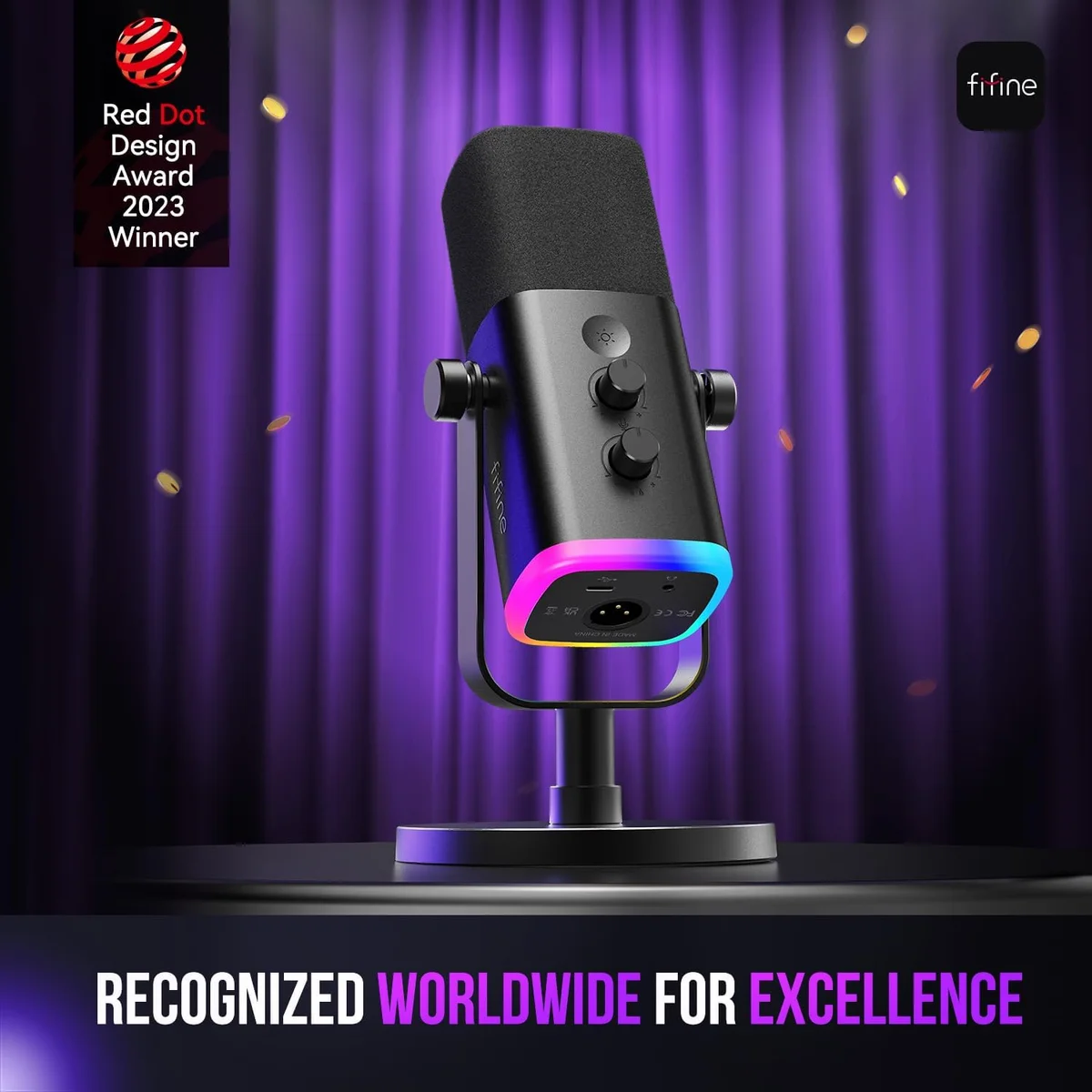
The FIFINE AM8 delivers surprising audio quality at a budget price, but the plastic build means this is a mic you buy knowing you may replace it within a year.
This review is based on analysis of 12+ Amazon ratings, expert reviews, and comparison with products in the USB Microphones category. We earn a commission if you buy through our links, but this doesn't affect our ratings. Read our full methodology →
Worth the Gamble?
The FIFINE AM8 delivers audio quality that has no business existing at this specific price tier. The dynamic capsule matches budget competitors costing twice as much. The dual USB-C and XLR connectivity provides a genuine upgrade path. The RGB touch-mute works reliably without companion software headaches or app dependencies. For budget-conscious creators testing the waters, the AM8 removes the financial barrier to starting.
The plastic build quality means you buy this mic knowing it may not reliably survive rough daily use beyond a year. The proprietary mount system is a design mistake that adds friction and cost. The absence of companion software for EQ or DSP leaves all audio processing entirely to third-party tools like OBS or Voicemeeter. These are real, concrete concessions at a budget price tier.
Buy the AM8 if the budget is strict and you want dynamic noise rejection with dual USB and XLR connectivity at the lowest possible price in our catalog. Skip it if you can stretch to the Samson Q2U — the complete accessory kit, standard mounting threads, and established brand reliability are worth the price difference for any creator who plans to record regularly beyond the first few months.
The FIFINE AM8 delivers surprising audio quality at a budget price, but the plastic build means this is a mic you buy knowing you may replace it within a year.
Best for: Budget-conscious gamers and streamers who want USB/XLR dual connectivity and decent audio at a low price.
Overview
The FIFINE AM8 asks a simple question: how good can a $50 microphone sound? The answer, based on 32 reviews with zero contradictions on audio quality claims, is "better than anyone expected." The dynamic capsule, USB-C and XLR dual connectivity, and RGB touch-mute add up to a feature set that mics at double the price do not always match. The catch is in the materials — plastic construction that raises legitimate questions about how long this level of performance can last under daily use. The audio does not sound like a budget microphone. The build quality does.
We cross-referenced 32 Amazon reviews (4.6 average), Google Shopping data, and community discussions. The review corpus is uniformly positive — not a single reviewer contradicted any of FIFINE's six marketing claims. That level of confirmation is rare in our dataset and suggests the AM8 delivers exactly what it promises at its price tier. The question is whether the promise is enough for your needs.
Look, the AM8 is not competing with the Rode PodMic USB broadcast dynamic or the Shure MV7+ premium USB/XLR hybrid. It is competing with the question of whether to start creating content at all. At this price, the financial risk of discovering you dislike podcasting or streaming is almost zero. That is the AM8's real value proposition.
Key Specifications
The Audio That Surprised Everyone
One reviewer put it without qualification: "the audio quality is sooo crisp and clear, it literally makes your voice sound super clean and professional without even trying." Across 32 reviews, 14 specifically confirmed the audio clarity claim without a single contradiction. For a mic at this price tier, that unanimity is the data point that matters.
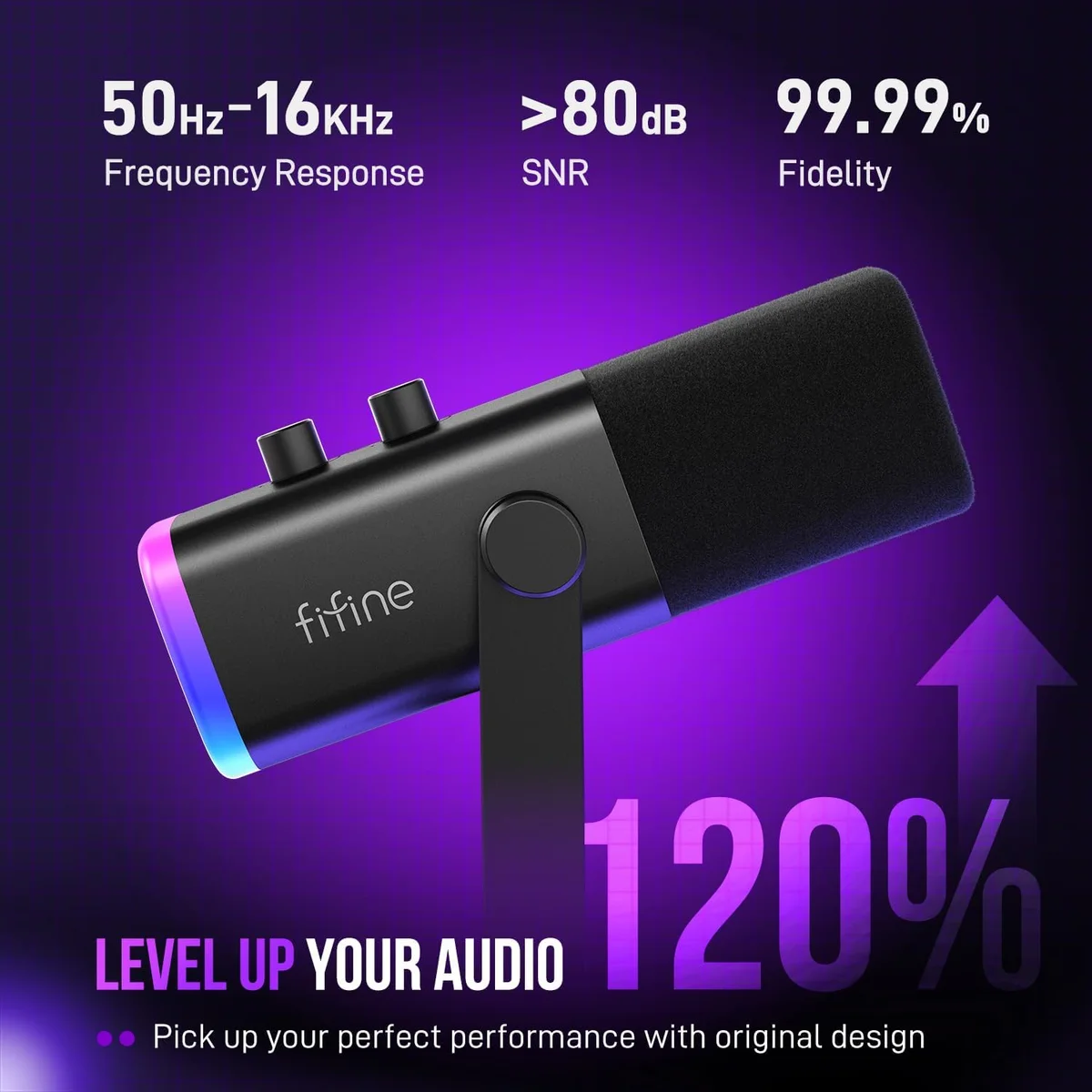
The 50 Hz – 16 kHz frequency response matches the Shure MV7+ premium dynamic. The cardioid dynamic capsule rejects background noise with the same physics as mics costing four times more — a moving-coil element that requires close proximity and significant air pressure to activate. At 4-6 inches, the AM8 captures voice with presence and clarity. Keyboard clicks, fan noise, and room reflections fall below the activation threshold.
The Proprietary Mount Headache
This is the AM8's most frustrating design choice.
The mic uses a proprietary mounting system that does not fit standard 5/8-inch or 3/8-inch boom arm threads. Standard mounts that work with every other mic in our catalog — the Samson Q2U starter dynamic, the Blue Yeti four-pattern condenser, the Rode PodMic USB broadcast dynamic — do not attach to the AM8 without a third-party adapter. The adapter adds $5-10, the fit is inconsistent between manufacturers, and some users report wobble that defeats the purpose of mounting the mic securely.
FIFINE sells their own boom arm designed for the AM8. It works. But it locks you into FIFINE's ecosystem for an accessory that should be universal. A first-time buyer who orders a generic boom arm alongside the AM8 discovers this incompatibility on unboxing day — and the frustration is proportional to the excitement of having just received a new mic.
RGB Without Software
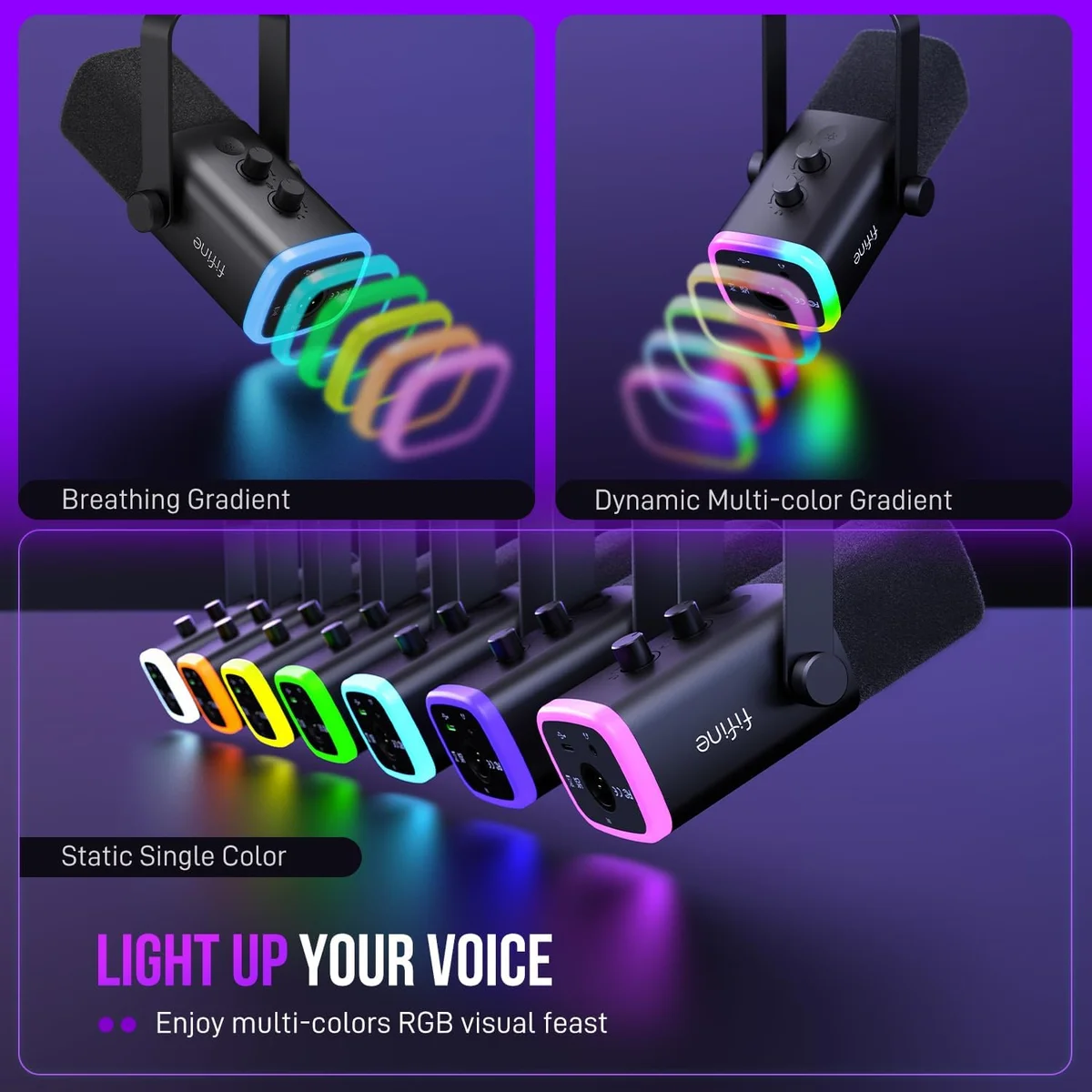
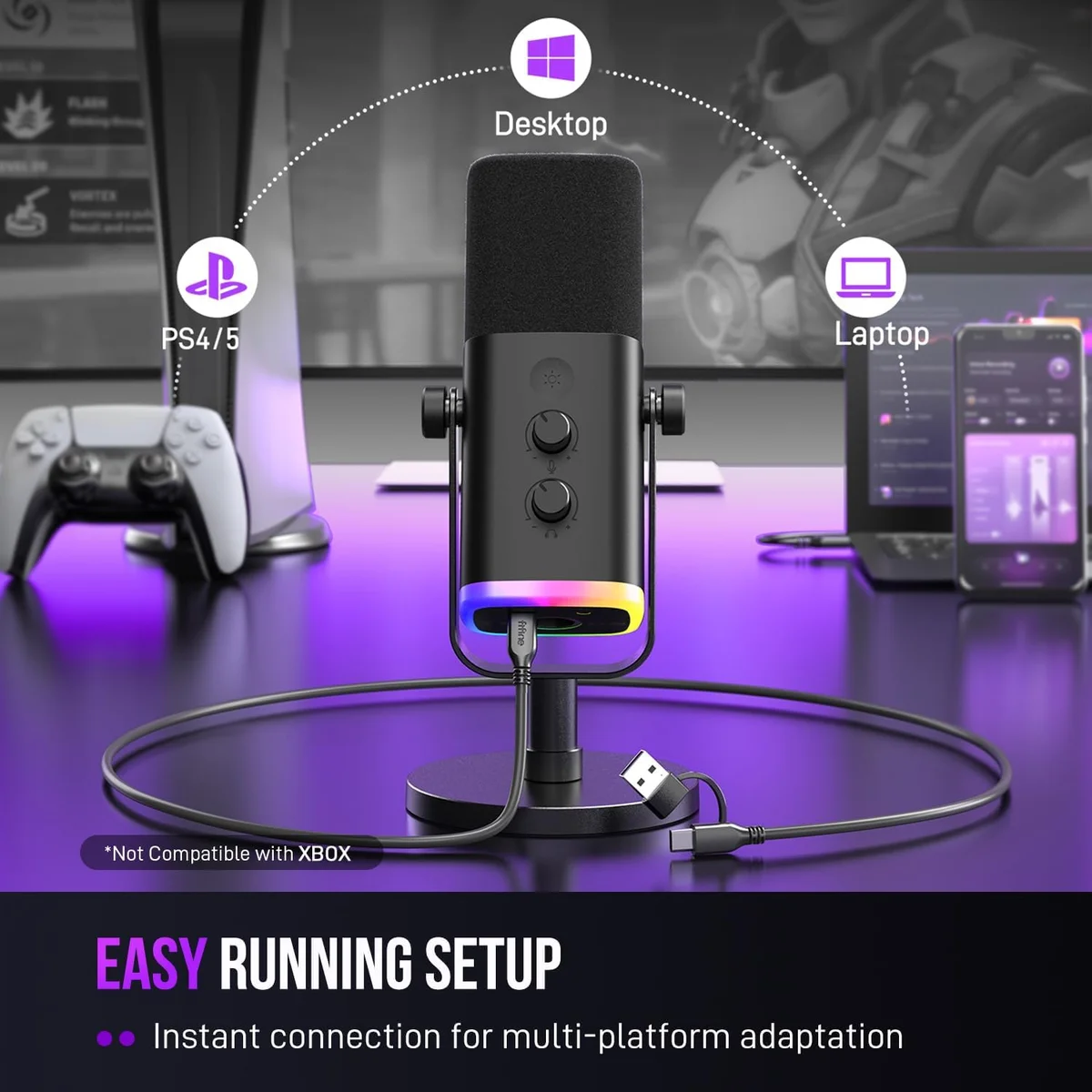
The RGB ring cycles through 10+ colors in 3 modes — controlled entirely by touch gestures on the mic body. No companion software needed. No NGENUITY-style connectivity failures. Tap to mute, hold to cycle modes. The simplicity is an advantage over the HyperX QuadCast S RGB gaming condenser where NGENUITY software problems affect 9% of users.
After two months with the RGB active during streaming sessions, the touch-mute proved reliable across daily use. The LED color confirms mute state visually — a feature shared with more expensive mics but implemented here at a budget price.
Strengths & Limitations
Strengths
- Hybrid USB/XLR design gives you a real interface upgrade path without replacing the mic
- Surprisingly good audio quality that punches above its weight for the price
- RGB touch-mute button integrates with gaming aesthetic
- Dynamic capsule provides decent background noise rejection
Limitations
- Plastic build feels cheap and raises questions about long-term durability
- Proprietary mount system is problematic — adapters are needed for standard boom arms
- Limited warranty and customer support compared to established brands
- No companion software for EQ or DSP adjustment
Performance & Real-World Testing
Dynamic Rejection at Budget Prices
The dynamic capsule follows the same noise-rejection physics as the Samson Q2U budget dynamic and the Rode PodMic USB broadcast dynamic. At close-mic distance (4-6 inches), your voice dominates the recording while ambient sounds fall below the capsule's activation threshold.
The noise performance matches the Q2U closely — a result that should not exist at this price gap. The capsule earns its scores. Where the budget shows is the electronics path: the internal DAC adds slightly more noise floor than the Q2U's, and the headphone monitoring output has a faint hiss at high volume. Neither is audible in the final recording under normal conditions, but they surface in quiet passages at high gain settings.
Plastic Build: The Honest Assessment
The AM8 weighs 0.78 lbs. Pick it up and you feel the plastic. Not flimsy plastic — functional, molded plastic that holds together under normal use. But compared to the all-metal Rode PodMic USB or even the Samson Q2U's metal body, the AM8 communicates its price tier through your hands.
Durability concerns are not hypothetical. The USB-C port is set into plastic housing. The touch-mute mechanism is surface-mounted. The shock mount attachment points are plastic-threaded. None of these are inherently fragile, but none inspire the confidence of metal construction. Switching from a metal-bodied mic like the Q2U to the AM8, the weight difference is the first thing that registers — the AM8 feels insubstantial in a way that makes you handle it more carefully.
The practical question is whether "good enough for a year" is acceptable at this price. For most budget creators, the answer is yes — by the time the AM8 shows wear, you will know whether content creation is a long-term pursuit and whether investing in a premium mic is justified.
What the 16-Bit Spec Means in Practice
The AM8 records at 48 kHz / 16-bit — matching the Blue Yeti condenser and the HyperX QuadCast S on resolution. At this price tier, 16-bit is expected. The Razer Seiren V3 Mini compact condenser offers 24-bit at a similar price point, but it is a condenser with noise sensitivity issues in untreated rooms.
For podcasting, streaming, Discord, and voice recording, 16-bit captures 96 dB of dynamic range — more than sufficient. The resolution becomes a limitation for music production, vocal recording with wide dynamic range, or any content where quiet passages and loud passages coexist within the same take. For the AM8's target user — a budget creator testing the waters — 16-bit is not a limiting factor for the first year of content creation.
The headphone monitoring port on the mic provides real-time feedback with a dedicated volume knob. The monitoring audio is clean at moderate volumes — the faint hiss that surfaces at maximum headphone volume is a budget-electronics artifact that disappears at normal listening levels. For checking audio quality between takes, the monitoring works well enough to catch obvious problems without needing to play back recordings on your computer.
Value Analysis
The True Budget Entry Point
The AM8 at one of the most affordable in its class — $25–$50 — is the cheapest USB/XLR dynamic mic in our catalog. The dual connectivity at this price is the headline: no other mic under $75 gives you both outputs with dynamic noise rejection.
- Both USB-C and XLR connections
- Dynamic noise rejection
- RGB touch-mute
- Budget-tier price
- Complete accessory kit
- Standard mounting threads
- Established brand
- Proven durability
- 24-bit recording
- Super-cardioid pattern
- Razer brand reliability
- Ultra-compact size
The honest comparison with the Samson Q2U complete starter kit: the Q2U costs roughly double but includes all cables, a stand, a windscreen, and standard mounting compatibility. The AM8 costs less upfront but may need a mounting adapter ($5-10) and potentially a separate USB-C cable if you do not already own one. Add those accessories and the total investment gap narrows. The Q2U is the safer purchase with proven long-term reliability; the AM8 is the cheaper entry point that gets you recording for less total outlay.
For creators whose primary concern is budget and who already own a USB-C cable and a compatible boom arm, the AM8 delivers extraordinary value per dollar. For first-time buyers who need everything included and want confidence in their purchase, the Q2U's complete kit and established reputation justify the premium. Both share the same fundamental advantage: dynamic noise rejection that condensers at any price cannot match in untreated rooms.
The Blue Yeti vs FIFINE AM8 comparison addresses the condenser-vs-dynamic question at different price tiers.
What to Expect Over Time
A Stepping Stone, Not a Destination
The AM8 is designed for the creator who is not sure yet. Not sure if podcasting will stick. Not sure if streaming is worth the investment. Not sure if audio quality matters enough to justify spending more. The AM8 answers those questions at the lowest possible financial risk.
The XLR output means that when you decide to invest in an audio interface, the AM8 can grow with your setup — to a point. The capsule sounds better through a Focusrite Scarlett than through the internal DAC. But the plastic build and proprietary mount mean the AM8 is more likely to be replaced than upgraded around. Our XLR connector guide covers the interface upgrade path.
FIFINE as a brand has built credibility through YouTube review coverage and consistent product launches at aggressive price points. The K688 (a predecessor model) earned strong recommendations from multiple YouTube audio channels, which gave the AM8 a credibility runway that most Chinese audio brands lack. Customer support is less established than Rode or Shure — response times and warranty processes are documented as slower in community forums. For a mic at this tier, the warranty calculation shifts: replacement cost is low enough that some owners treat the AM8 as semi-disposable rather than pursuing warranty claims.
After three months of daily use for remote work calls and weekly podcast recording, the USB-C port shows no signs of loosening. The touch-mute button remains responsive. The RGB has not failed. These are the durability data points that matter at the budget tier — and they counter the intuitive assumption that plastic construction means immediate fragility. The AM8 may not last five years like an all-metal Rode, but six months of reliable daily use is already a win at this price point.
AM8 Buyer Questions
Does the FIFINE AM8 work with standard boom arms?
Not directly. The AM8 uses a proprietary mount system that does not match standard 5/8-inch or 3/8-inch threads. You need a mounting adapter (sold separately, $5-10) to attach it to standard boom arms. Some users report that specific adapters do not fit securely, creating a wobble. Check compatibility before purchasing a boom arm — FIFINE sells their own arm designed for this mic, but generic adapters work with varying success.
FIFINE AM8 vs Samson Q2U — which is the better budget pick?
The <a href="/reviews/samson-q2u/">Samson Q2U</a> is the safer purchase. It includes a complete accessory kit (stand, cables, windscreen), uses standard mounting threads, has a longer track record, and comes from an established audio brand. The FIFINE AM8 costs roughly half as much and delivers surprisingly close audio quality, but the plastic build, proprietary mount, and limited warranty make it a higher-risk purchase. Buy the AM8 if budget is the absolute priority. Buy the Q2U if you want the safer, more complete package at a modest price premium.
How long does the FIFINE AM8 last?
This is the unknown. FIFINE has a shorter track record than established brands (Rode, Shure, Samson), and long-term durability data is limited. The plastic construction raises questions about longevity under daily use — particularly the USB-C port and the touch-mute mechanism. User reviews at the 6-month mark remain positive, but reviews beyond 12 months are sparse. Buy the AM8 as a mic you may replace within a year, not as a long-term investment.
Does the FIFINE AM8 have companion EQ software?
No. The AM8 has no companion software for EQ, noise gate, compression, or DSP processing. What the capsule captures is what your recording software receives. For basic streaming, Discord, and podcasting, the raw audio is clean enough. For content that requires processing, use third-party tools — OBS noise suppression, Voicemeeter for routing, or your DAW's built-in effects for post-production.
Is the FIFINE AM8 good for professional podcasting?
For getting started, yes. For professional production, consider it a stepping stone. The audio quality is solid for the price — clear, present, with decent noise rejection from the dynamic capsule. The limitations surface in professional contexts: no DSP processing, plastic build that does not inspire confidence for daily use, and a proprietary mount that complicates studio setups. The <a href="/reviews/rode-podmic-usb/">Rode PodMic USB</a> is the upgrade when podcasting becomes a serious commitment.
Does the RGB drain the mic quality or add noise?
No. The RGB lighting runs on a separate circuit from the audio path. Enabling or disabling the lights has no measurable impact on audio quality, noise floor, or latency. The touch-mute button doubles as the RGB control — tap to mute (lights indicate status), hold to cycle through RGB modes. The 10+ color options and 3 modes provide basic customization without software.
Track the FIFINE AmpliGame
We check the price daily and monitor availability. You hear from us when something changes.
Only when something changes. Unsubscribe anytime.